
FreebiePublic
Profileschool, Dmitry Larionov | Montage theory. Levels 1-4 (2025) PCRec [AD] [RU]
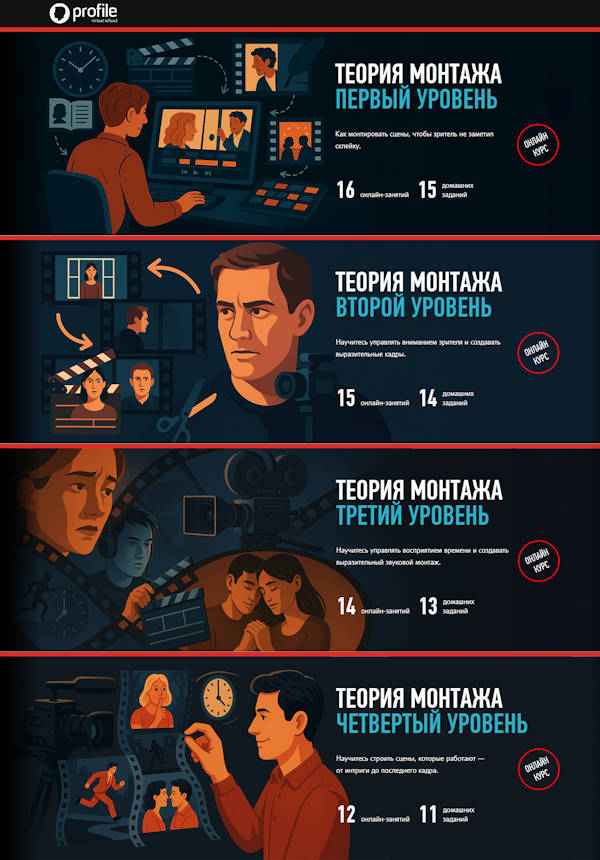
Profileschool, Dmitry Larionov | Теория монтажа. Levels 1-4 (2025) PCRec [AD] [RU]
Author: Dmitry Larionov
Production: Profileschool
Genre: Video editing
Description:
The course “Editing Theory” is a fundamental online course for future editors and those who want to seriously master the profession.
It consists of four levels:
- First level - the basics.
- In the second level you will learn composition, working with the face, split screen and visual accents.
- In the third level you will master parallel editing, flashbacks and associative techniques.
- In the fourth level you will master suspense, pacing, scene joining and internal dramaturgy - editing that tells the story.
It is recommended to go through the levels sequentially - this way you will understand the material more deeply and confidently master the profession of an editor.
Duration: 60:01:13
Video quality: PCRec
Voice language: Russian
Advertising: Third-party inserts and overlays on video
Screenshots:
Distribution time: s 16:00 to 22:00 (until the first 3-5 downloaders appear)
Author: Dmitry LarionovProduction: Profileschool
Genre: Video editing
Description:
The course “Editing Theory” is a fundamental online course for future editors and those who want to seriously master the profession.
It consists of four levels:
- First level - the basics.
- In the second level you will learn composition, working with the face, split screen and visual accents.
- In the third level you will master parallel editing, flashbacks and associative techniques.
- In the fourth level you will master suspense, pacing, scene joining and internal dramaturgy - editing that tells the story.
It is recommended to go through the levels sequentially - this way you will understand the material more deeply and confidently master the profession of an editor.
Duration: 60:01:13
Video quality: PCRec
Voice language: Russian
Advertising: Third-party inserts and overlays on video
Editing theory. Level One.
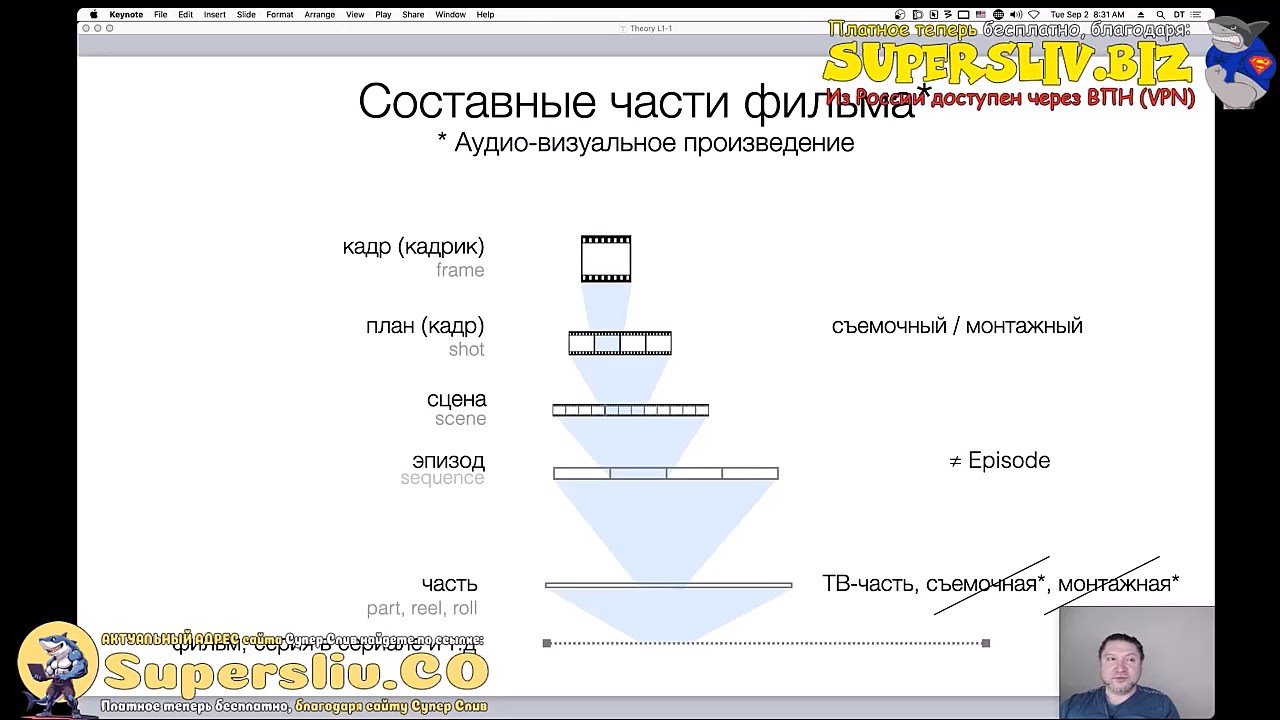
At the first level of the course, you will learn the key principles that underlie editing - from choosing coarseness and constructing mise-en-scène to creating smooth transitions between shots and managing the viewer's attention.
This course is the foundation for anyone who wants to understand editing not as a series of random cuts, but as a system that conveys meaning, rhythm and emotion. We will look at the basics of the visual language of cinema, learn how to read and frame a frame, “hide” editing and manage the space of the scene. We'll focus on dialogue and motion editing—key skills for any video editor. You will master the techniques of axial editing, learn how to arrange scenes along the interaction axis, work with the figure eight and competently break these rules for expressiveness. We will also study in detail motion editing: phase, direction, mass and speed of an object in the frame - and how to use them to direct the viewer’s attention. This course will help you create editing that makes sense, rather than catches the eye.
Editing theory. Level two.
At level two we delve into the visual techniques with which the editor can control the perception of the scene. You'll learn to work with close-ups, understand how camera angle and position affect perception, and create a composition that leads the viewer's eye where you want it to go. We'll look at how close-up and camera position work together, what editing by gaze is, and how to use the face as the main carrier of emotions. Particular emphasis is on the composition of the frame: we will learn to create accents, use contrast and even deceive the viewer through compositional solutions.
You will learn to assemble scenes taking into account balance and “swing” - moving accents between characters and actions, create dynamics using facial expressions, reflections and subjective points of view. We will work with non-standard angles, study the techniques of Reverse Framing and Negative Space, as well as ways to control the space of the frame - from an empty background to double exposure. The course will help you not just arrange frames one after another, but build scenes in which composition and emotion work for one result: viewer involvement.
Editing theory. Third level.
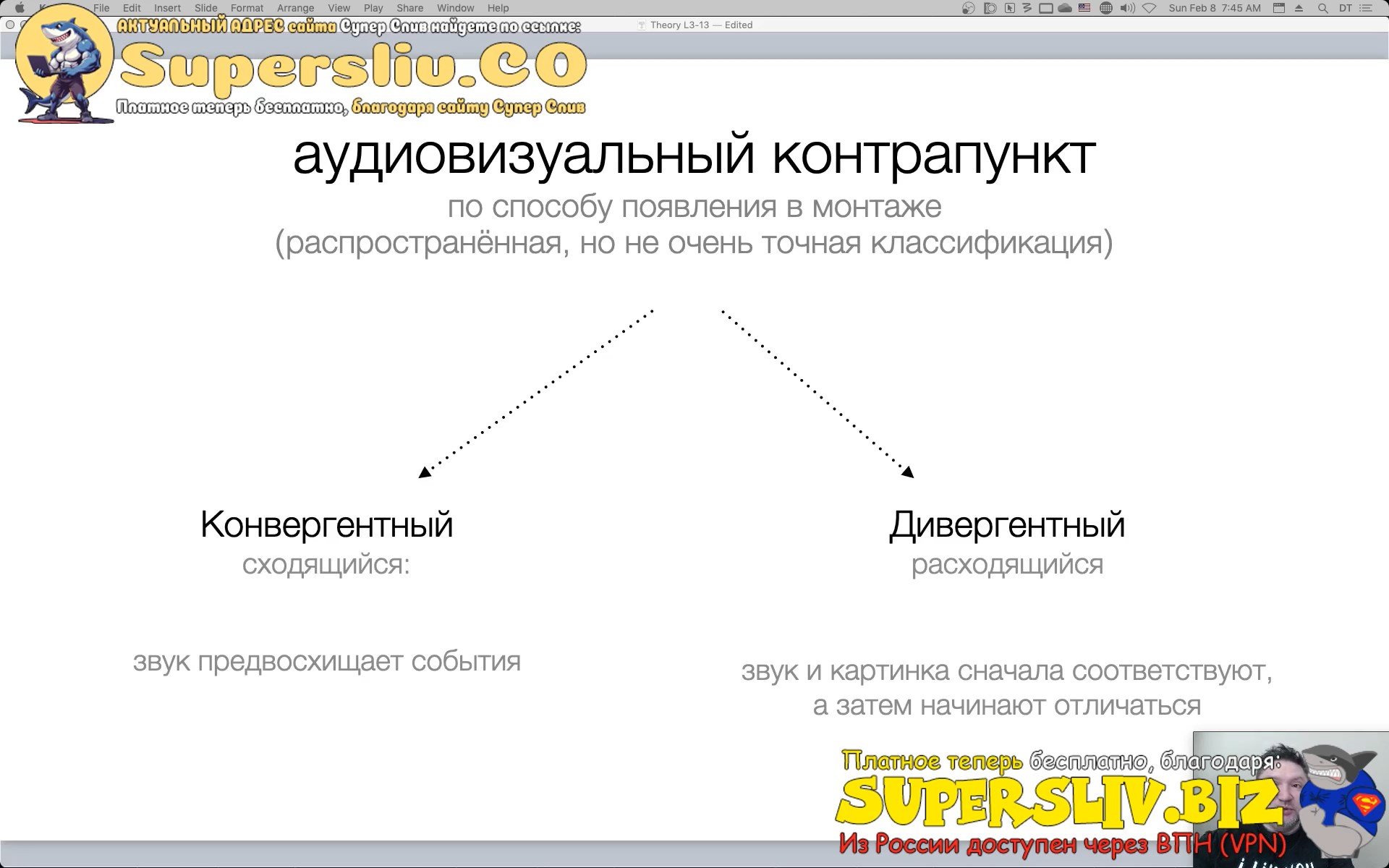
At the third level you will learn to see editing not only in space, but also in time. We explore how to “stretch” or “compress” an event, how to mix past and future, how to create parallel stories and convey emotions through sound. This is a course on how to edit not only images, but also meaning. Here you will learn how sound changes the perception of a frame, how editing phrases are constructed and why the same shot can work differently depending on its duration, sound design and position in the scene.
We will analyze the types of screen time - from ultra-short microshots to extended scenes where a pause says more than words. You'll learn how to work with parallel structures, elliptical editing and flashbacks, as well as master Link Editing and skew cuts for expressive sound transitions. We will pay special attention to associative montage - a way to create new meanings through visual or sound rhymes, as well as counterpoint - editing by contrast. This level helps to master editing as a rhythmic, sensual and intellectual art.
Montage theory. Level Four.
At the final fourth level of the course, you will learn how to structure scenes as complete dramatic units. We'll look at how scenes connect, how to manage emotional curves, pacing and rhythm, and how to create suspense and tension even without words. Это курс о глубине. Here editing becomes a tool not just for connecting frames, but for creating a real narrative. You will learn how to design a scene so that it ends effectively, how to use bookending, stop-frame, suspense and pay-off so that the scene remains in memory.
We will analyze in detail the techniques of constructing dialogue-free scenes and editing episodes, learn how to use Overlap Edit and delayed reactions to stitch together scenes based on action or sound. We will pay special attention to working with the beginning and end of the scene, forming an “emotional button” and creating effective endings. You will master methods of tempo organization: how to manage pauses, switch rhythms, use static and movement in the frame. This level is the final one - it turns editing from a set of techniques into a director’s tool that allows you to tell a story so that it holds the viewer until the last frame.


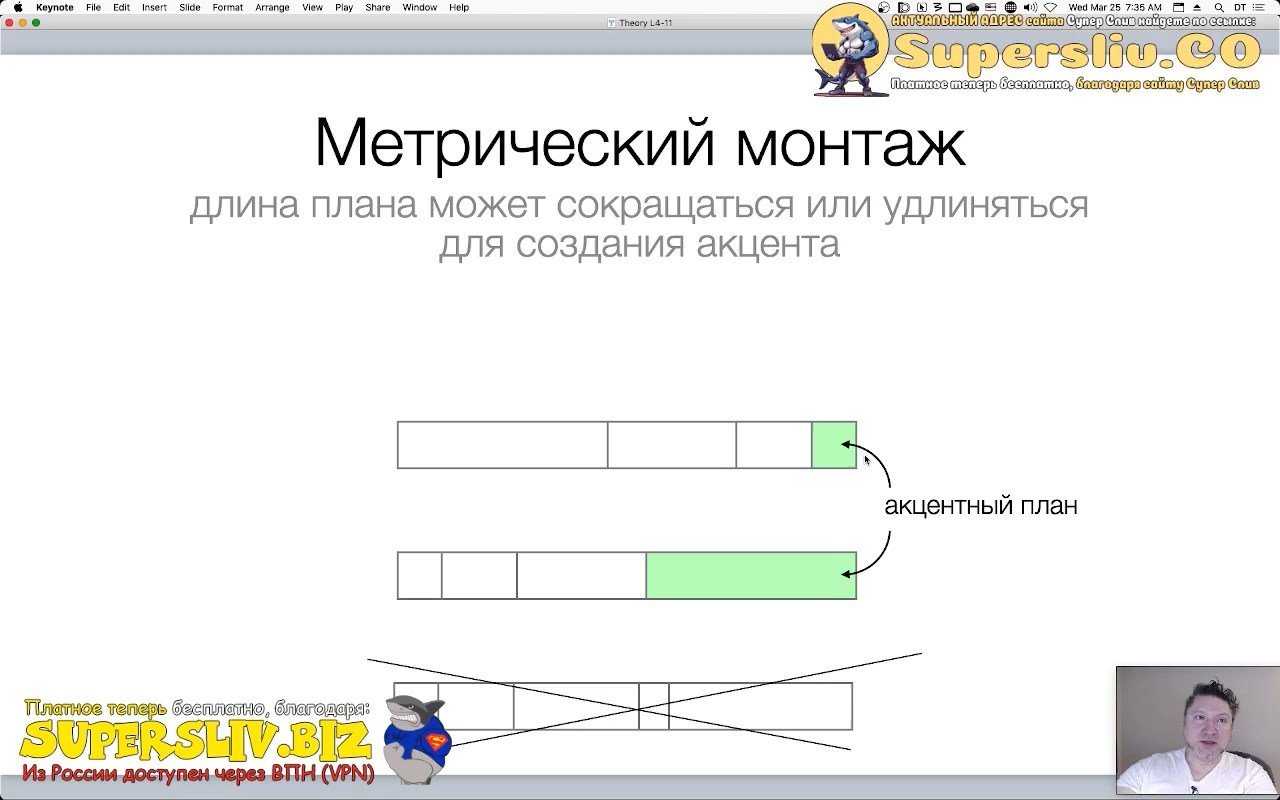
Distribution time: s 16:00 to 22:00 (until the first 3-5 downloaders appear)
Get This Freebie
User Reviews
See what others are saying about this.
0.0
Based on 0 reviews
Write A Review
You must be logged in to leave a review.
Login NowNo Reviews Yet
Be the first to share your thoughts!