
FreebiePublic
Higher School of Film Engineers, Oleg Berezin, Evgenia Grinenko, Konstantin Glassman | Media broadcasting technologies (2026) WEB-DL [RU]
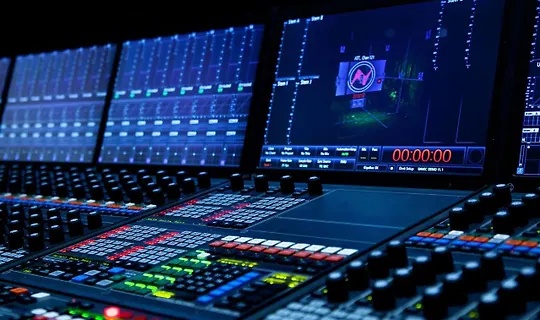
Higher School of Film Engineers, Oleg Berezin, Evgenia Grinenko, Konstantin Glasman | Media broadcasting technologies (2026) WEB-DL [RU]
Authors: Oleg Berezin, Evgenia Grinenko, Konstantin Glassman
Production: Higher School of Film Engineers (CHOU DPO "VShKI")
Genre: video course, media broadcasting, television, ProAV, video engineering, audio technologies, IP broadcasting
Description:
Professional retraining “Media Broadcasting Technologies” is a systematic course for specialists working in television, cinema, ProAV and multimedia. You will get answers to difficult questions that arise every day in your work: what is the white point and why is it different? what happens when you change the "release time" parameter in an audio compressor? How do PQ and HLG work? What is the difference between wavelet codecs and DCT codecs? how does FEC work and what IP technologies are used in the media industry?
This is not a set of isolated lectures, but a comprehensive program that helps you understand the principles of operation of modern media technologies and learn how to apply them in practice - to design, configure and develop media systems with confidence.
Duration: 137:17:38
Quality video: WEB-DL
Voice language: Russian Screenshots:
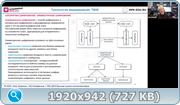
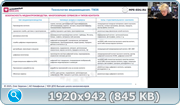
Distribution time: 24/7 (around the clock) (at least until the first 3-5 downloaders appear)
Authors: Oleg Berezin, Evgenia Grinenko, Konstantin GlassmanProduction: Higher School of Film Engineers (CHOU DPO "VShKI")
Genre: video course, media broadcasting, television, ProAV, video engineering, audio technologies, IP broadcasting
Description:
Professional retraining “Media Broadcasting Technologies” is a systematic course for specialists working in television, cinema, ProAV and multimedia. You will get answers to difficult questions that arise every day in your work: what is the white point and why is it different? what happens when you change the "release time" parameter in an audio compressor? How do PQ and HLG work? What is the difference between wavelet codecs and DCT codecs? how does FEC work and what IP technologies are used in the media industry?
This is not a set of isolated lectures, but a comprehensive program that helps you understand the principles of operation of modern media technologies and learn how to apply them in practice - to design, configure and develop media systems with confidence.
Duration: 137:17:38
Quality video: WEB-DL
Voice language: Russian
- Television, radio broadcasting and ProAV engineers who want to systematize knowledge and understand modern standards.
- Multimedia and IP infrastructure of media complexes.
- Video and audio engineers seeking to delve into color models, compression and networking of equipment.
- System administrators and technical managers responsible for setting up and operating broadcast equipment.
- Students and aspiring professionals planning a career in media technology.
- Basic understanding of digital video and audio principles (formats, resolutions, sample rates).
- Experience with professional broadcast or AV equipment (cameras, mixers, encoders, switches).
- General understanding of network technologies (TCP/IP, VLAN, routing) will be useful.
- Be prepared to work intensively with technical terminology and mathematical foundations (Fourier transforms, information theory).
- Understand the physics and mathematics of converting light and sound into media signals.
- Understand color standards (white point, gamma, Log curves, LUTs, Rec.709/2020 color spaces, DCI-P3, ACES).
- Work with dynamic range (SDR, HDR, PQ, HLG) and high frame rate (HFR) systems.
- Apply audio and video compression technologies (MP3, AAC, Dolby AC-3, H.264/HEVC, JPEG XS, wavelet codecs).
- Use channel coding (Hamming, Reed-Solomon, LDPC, FEC codes) to increase noise immunity.
- Design and configure IP media networks based on SMPTE ST 2110, NMOS, SRT, RIST, NDI, AES67.
- Configure equipment and carry out measurements (oscilloscopes, vectorscopes, packet analyzers).
- Evaluate broadcast quality (QoS, QoE) and work with media containers (MPEG-TS, MXF, IMF, DCP).
The course is built on the basis of many years of experience of teachers - current industry experts. The program covers all key aspects of modern media technologies: from signal physics to IP infrastructure and cloud solutions. Particular attention is paid to practical classes and laboratory work, where students work with real equipment (cameras, mixers, switches) and measuring instruments, and also analyze network traffic using Wireshark.
Training takes place in interactive mode (Zoom) with the obligatory inclusion of a video camera, which ensures live communication and the opportunity to immediately ask questions. All lectures are recorded, and materials (presentations, diagrams, tables) are provided in PDF format. The course is designed for 192 academic hours and provides a deep systemic understanding necessary for confident work in a rapidly changing media environment.
- Block A. Media systems and technologies
- Signals and systems (Shannon’s theorem, modulation, spectra, Nyquist barrier)
- Conversion of the sound field into a sound picture (microphones, ADC/DAC, AES/EBU interface)
- Conversion of the light field of an object into a flat optical image (optics, lenses, light quantities)
- Conversion of an optical image into a video signal (CCD/CMOS sensors, scanning, ADC)
- Conversion of a video signal into an image (displays: LCD, OLED, microLED, color coverage)
- Basic control and processing technologies (measuring signals, gamma correction, white balance)
- Audio compression technologies (psychoacoustics, MP3, AAC, Dolby AC-3)
- Video compression technologies (intra-frame/inter-frame, JPEG, MPEG-2/4, H.264/HEVC, JPEG XS)
- Channel coding technologies (Hamming, Reed-Solomon codes, LDPC, FEC)
- Digital television broadcasting systems (DVB, ATSC, ISDB)
- Signals and systems (Shannon’s theorem, modulation, spectra, Nyquist barrier)
- Unit B. Digital signal processing and related disciplines
- Digital signal processing (sampling, modulation, synchronization)
- Video signals and video interfaces (SDI, HDMI)
- Optics fundamentals (light quantities, lenses, sensors, EOTF/OETF)
- Color representation (color spaces, LUTs, Log curves, Rec.709/2020, DCI-P3, ACES)
- Dynamic range (SDR, HDR, HDR10, PQ, HLG)
- Shooting and playback speed (HFR, Slow Motion, artifacts)
- Sound in media production (formats 5.1, Immersive Audio, PCM, WAVE, AES3)
- Lighting devices (types, color temperature, artistic lighting)
- Media signal compression (entropy coding, codec comparison, BD-rate, PSNR)
- Digital signal processing (sampling, modulation, synchronization)
- Block B. Networks, transmission and modern standards
- IP basics (OSI, Ethernet, TCP/UDP, Multicast, PIM, IGMP, DNS, REST API)
- Encryption (symmetric/asymmetric, TLS, HTTPS, OAuth 2.0)
- Error detection and correction algorithms (FEC, ARQ, SMPTE 2022-7)
- Media containers (MPEG-TS, MP4, MOV, QT)
- Storage and exchange formats (MXF, IMF, DCP)
- Data presentation formats (XML, JSON)
- Transmission and broadcast technologies (SRT, RIST, NDI, RTSP, WebRTC, RTMP, M-DASH, HLS, CMAF, SMPTE ST 2110, IPMX)
- Transmission of audio data in IP networks (Dante, Livewire, Ravenna, AES67, NGA, ADM)
- Device discovery, registration and management (NMOS API)
- Digital cinema projection and displays (DCP, DLP Cinema, LED screens, EDID)
- Media broadcast quality assessment (QoS, QoE, qualimetry)
- Measurements (oscilloscopes, vectorscopes, waveform monitors, Wireshark)
- Subtitles (formats, standards, protocols)
- Data modeling (UML, JT-NM reference architecture)
- IP basics (OSI, Ethernet, TCP/UDP, Multicast, PIM, IGMP, DNS, REST API)
- Practical exercises and laboratory work
- Switching devices and media systems
- Working with audio mixing remote control
- Configuring a digital cinema camera (white balance, mixing cameras)
- Configuring a video mixer and multiviewers
- Internet broadcasting setups
- Measurements of media signals (vectorscope, oscilloscope)
- Acoustic measurements, frequency response of the hall, reference level volume
- Configuring the media complex network, firewall, PTP
- Analysis of RTP media packets, SNR/BER measurement
- Comparison of codecs (efficiency, bitrate, CPU load)
- SDI conversion ↔ ST 2110 ↔ SDI, SRT testing (latencies, jitter, losses). JSC "Nevafilm", Chairman of the Russian section of SMPTE.
- Grinenko Evgenia Nikolaevna - Associate Professor of the Department of Television of St. Petersburg State Technical University "LETI", video director of the Philharmonic named after. D. D. Shostakovich.
- Glasman Konstantin Frantsevich - senior researcher at the Department of Television of St. Petersburg State Technical University "LETI".
- Switching devices and media systems
Modern television, cinema and ProAV are rapidly moving on IP infrastructure and cloud solutions. Specialists who understand not only traditional SDI approaches, but also network technologies, compression standards, color spaces and error correction methods become indispensable. The course provides up-to-date knowledge that allows you not only to operate, but also to design media systems of the future, ensuring high quality and reliable broadcasting.


Distribution time: 24/7 (around the clock) (at least until the first 3-5 downloaders appear)
Get This Freebie
User Reviews
See what others are saying about this.
0.0
Based on 0 reviews
Write A Review
You must be logged in to leave a review.
Login NowNo Reviews Yet
Be the first to share your thoughts!